Showing posts with label custard. Show all posts

Thursday, July 21, 2011

Not-so-plain Vanilla Ice Cream

Vanilla ice cream by Lucy Mercer/A Cook and Her Books
Sometimes, I get so distracted by trying to something new that I forget that the classics are classics for a reason - they never let you down. My most recent example: my baby girl turned 13 last week, thir-teen! and she requested a rich chocolate birthday cake. Not my go-to chocolate pound cake, but something a little fancier. I found a pretty Ina Garten chocolate layer cake that filled the bill and started baking. Now, I've been putting together cakes for a long time, and this has never happened to me - when I pulled the layers out of the oven, they sank into themselves, becoming dark chocolate Frisbees.

Time for Plan B: my hasn't-failed-me-yet fudgy brownie recipe with a side of homemade vanilla ice cream. I love to make ice cream at home.

Ice cream freezer by Lucy Mercer/A Cook and Her Books
And no, that's not my everyday ice cream maker - just a $4 estate sale find from a few years ago. I use a Krups La Glaciere, the kind with the canister you pop into the freezer (really, it's best to just keep it in the freezer all summer long so it's always ready for ice cream-making).

You can make this ice cream ahead of time and let it harden in the freezer, but I think it's best served soft, just out of the canister. The generous dose of cream fluffs up, creating a silky mouthfeel. Served alongside a warm, fudgy brownie, it's a winning birthday dessert.


Not-So-Plain Vanilla Ice Cream

¾ cup sugar

2 cups whole milk

2 eggs

1 pint (2 cups) whipping cream

1 tablespoon vanilla extract


1. Prepare your ice cream maker before beginning the recipe. I use a Krups La Glaciere that requires the canister to be frozen about a day in advance. It resides in my freezer during prime ice cream-making months. If going the rock salt-and-ice route, make sure you have plenty of salt and ice, the canister is clean and that you have a place to churn the ice cream, and if it requires hand-cranking, gather the excited young’uns together and tell them they’re about to experience one of the great joys of childhood: cranking ice cream.

2. In a medium saucepan, and I use nonstick, combine sugar and eggs over medium heat. Heat milk in measuring cup in microwave for one minute to take the refrigerator chill off of it and then whisk it into egg mixture. Continue cooking over medium heat, whisking all the while, until mixture thickens and coats the back of a metal spoon, about 10 minutes.

3. Have ready a bowl and sieve. Remove custard from heat and pour through sieve to remove any egg solids, (discard the solids, of course). Let custard cool, then place in airtight container and refrigerate for up to two days.

4. When ready to freeze, add whipping cream and vanilla and freeze according to ice cream maker’s instructions. This ice cream is fluffy and soft served from the ice cream maker. Place any leftover ice cream in an airtight container and store in freezer.


Brownie and vanilla ice cream by Lucy Mercer/A Cook and Her Books

Monday, November 1, 2010

The frost on the pumpkin


Glass pumpkins at the Atlanta Botanical Garden. Lucy Mercer/A Cook and Her Books

The frost on the pumpkin is a phrase that weathermen and old timers toss about this time of year, but I've never been too sure what it means or the origin of the phrase. If I'd been raised in the Midwest, I may have known it - just like Georgians are schooled on Sidney Lanier's poetry ("Out of the hills of Habersham, Down the valleys of Hall"), apparently Indianans are raised on the poetry of James Whitcomb Riley, the "Hoosier Poet."

The poem concerns the turn of the seasons on a mid-19th century Indiana farm. It's in dialect, but the charm of the lines shines through:


WHEN the frost is on the punkin and the fodder's in the shock,
And you hear the kyouck and gobble of the struttin' turkey-cock,
And the clackin' of the guineys, and the cluckin' of the hens,
And the rooster's hallylooyer as he tiptoes on the fence;
O, it's then the time a feller is a-feelin' at his best,        
With the risin' sun to greet him from a night of peaceful rest,
As he leaves the house, bareheaded, and goes out to feed the stock,
When the frost is on the punkin and the fodder's in the shock.
  
They's something kindo' harty-like about the atmusfere
When the heat of summer's over and the coolin' fall is here— 
Of course we miss the flowers, and the blossoms on the trees,
And the mumble of the hummin'-birds and buzzin' of the bees;
But the air's so appetizin'; and the landscape through the haze
Of a crisp and sunny morning of the airly autumn days
Is a pictur' that no painter has the colorin' to mock— 
When the frost is on the punkin and the fodder's in the shock.
  
The husky, rusty russel of the tossels of the corn,
And the raspin' of the tangled leaves as golden as the morn;
The stubble in the furries—kindo' lonesome-like, but still
A-preachin' sermuns to us of the barns they growed to fill; 
The strawstack in the medder, and the reaper in the shed;
The hosses in theyr stalls below—the clover overhead!—
O, it sets my hart a-clickin' like the tickin' of a clock,
When the frost is on the punkin and the fodder's in the shock.
  
Then your apples all is gethered, and the ones a feller keeps 
Is poured around the cellar-floor in red and yaller heaps;
And your cider-makin's over, and your wimmern-folks is through
With theyr mince and apple-butter, and theyr souse and sausage too!...
I don't know how to tell it—but ef such a thing could be
As the angels wantin' boardin', and they'd call around on me— 
I'd want to 'commodate 'em—all the whole-indurin' flock—
When the frost is on the punkin and the fodder's in the shock.
 

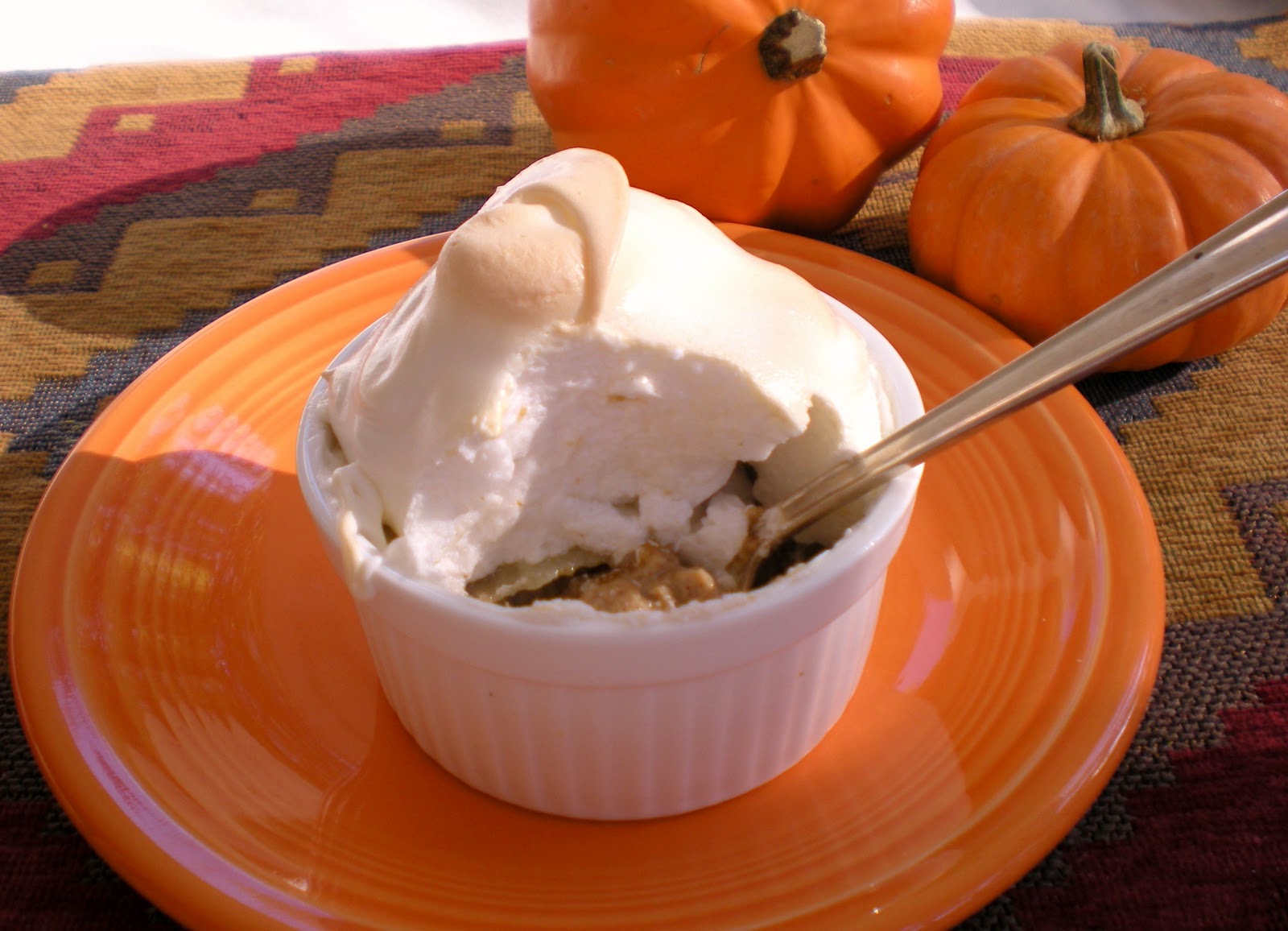
With Riley's words as inspiration, I concocted a dessert of spiced pumpkin custard topped with frost, a billowy pillow of meringue.

Pumpkin custards with meringue. Lucy Mercer/A Cook and Her Books


The Frost on the Pumpkin:
Pumpkin Custards with Meringue
Serves 4

1 cup heavy cream

1 egg yolk plus 2 whole eggs, lightly beaten

1/2 cup canned pumpkin puree

2 tablespoons maple syrup

1 tablespoon sugar

1 teaspoon cinnamon

1/2 teaspoon allspice.

1. Preheat oven to 325. Butter four 1/2 cup custard cups. Fill a teakettle with water and heat to boiling.

2. Heat cream in a small, heavy saucepan. Remove from heat and temper the yolks by slowly pouring half of the cream into the egg yolks, whisking all the while. Pour the yolk mixture into the remaining cream. Stir in pumpkin, maple syrup, sugar, cinnamon and allspice. Strain the mixture and pour into custard cups.

3. Set the custard cups in a baking pan. Place pan  in oven and gently pour boiling water from teakettle into pan, halfway up the sides of the cups, being careful not to splash the custards.

4. Bake at 325 for about 40 minutes, or until set. Remove from oven and let cool. These are delicious at this point, but if you want to gild the lily (or Indiana's state flower, the peony!), add a frosting of meringue.

Digging in to a meringue-topped pumpkin custard. Lucy Mercer/A Cook and Her Books


Meringue

4 egg whites

1/3 teaspoon cream of tartar

7 tablespoons sugar

1/2 teaspoon vanilla extract

Pinch of salt

1. In the very clean bowl of an electric mixer, pour in egg whites and and cream of tartar and whip lightly for a minute. Gradually increase speed of mixer and add sugar one tablespoon at a time until the peaks are stiff and glossy. Stir in vanilla extract and a pinch of salt.

2. Swirl meringues onto pumpkin custards and bake in a preheated 350 degree oven for about 10 minutes or until lightly brown. Serve warm.

 
A pumpkin from my garden. Lucy Mercer/A Cook and Her Books.


Text & images copyright 2010, Lucy Mercer with the exception of the text of the poem.

"The Frost is on the Punkin" quoted from www.bartleby.com

The glass pumpkins are from the Cohn-Stone Studios in California and are on display at the Atlanta Botanical Garden. 

The recipes are adapted from the Martha Stewart Cookbook (1995, Clarkson Potter)

Tuesday, January 26, 2010

Lemon Pudding Love


Lemons by Lucy Mercer/A Cook and Her Books


After 20 years of marriage, you think I’d know this companion, best friend, loving father of my children. A man who professes to dislike desserts because they are “too sweet,” who can turn down chocolate with a dismissive wave, cheesecake with a grimace. But now, aha! I have found a chink in his armor, an irresistible temptation - lemon pudding. Lemon pudding, satiny and creamy, lush and plush, tongue-tickling tart and eye-brightening sweet, every mouthful a citrus melody in a composition of custard.

I’ve never made the pudding specifically for my husband; it’s my firstborn daughter’s favorite. She had a rough day today, and when she got in the car after school, recounted all her grievances, then got that faraway look in her eyes and adopted a petulant tone, “Why don’t you ever make lemon pudding? You know it‘s my favorite.” And later, at home, I check the refrigerator and see that I have a bag of lemons and the organic eggs that my neighbor brought by; it’s kismet.

The recipe’s a keeper, rich with half and half (you can sub whole milk), sugar and a quartet of egg yolks. And lemon, at least four juicy lemons and their zest are required for this batch. If all goes according to plan, the pudding will not need refrigeration because it will be scarfed down while barely warm, which we all know is the proper temperature for all homemade puddings. Mr. Cosby can keep his Jell-puddings in the fridge; all their generic flavors and paintbox colors. Real pudding, the kind that mommas make for their babies (of any age), is best eaten warm from the pot it’s made in, with a big spoon.

I make lemon pudding in a double boiler, and strain in a sieve, which is the culinary equivalent of Grandpa wearing a belt and suspenders. The gentle heat of the double boiler ensures the eggs don’t scramble and the sieve makes sure that any wayward lumps, plus the fine zest, do not interfere with the supremely creamy texture of the pudding.

Back to the husband - I placed the bowl of strained pudding on the table, the curds in the strainer in the sink and went about the making of supper. Dear Husband asked what was in the sink. I said, honey it’s lemon pudding, that’s just the offal, wait for the real stuff, we‘ll have it for dessert. I snuck a look and saw him hunched over the strained lemon bits like a lion on a zebra carcass and I swear, for the love of Peter Brady and all that is holy, for a split second, my husband’s eyes rolled back in his head.

You can believe what you want to believe, but this momma’s going to be making more lemon pudding.


Lemon Pudding by Lucy Mercer/A Cook and Her Books


Lemon Pudding

2-1/4 cups half and half or whole milk
¾ cup granulated sugar
¼ cup light brown sugar
1/4 cup cornstarch
4 large egg yolks
1 teaspoon vanilla extract
2 tablespoons finely grated lemon zest (from 2 lemons)
Pinch salt
1/2 cup fresh lemon juice (about four small lemons)
3 Tbs. unsalted butter, at room temperature (optional if using the half and half)

1. Set up a double boiler and place over medium heat. In top pan, whisk together the milk, sugars and cornstarch until smooth and not lumpy.

2. Whisk in the egg yolks, lemon zest and pinch of salt. Continue cooking, whisking frequently at first and constantly toward the end, until thickened to desired consistency, 10 to 15 minutes.

3. Remove the pan from the heat, add the lemon juice and butter (if using), and stir until incorporated. Pour through a coarse sieve into a large serving bowl and let cool to room temperature.

4. If you must refrigerate right away, cover it with plastic wrap let chill for two hours. In my home, I pour out small servings in bowls, set out spoons, and announce that pudding is ready.

Text and images copyright 2010, Lucy Mercer.