Eggplant and tomato spaghetti. Lucy Mercer/A Cook and Her Books
At the height of summer, when the markets are filled with Technicolor produce, pick out a beautiful, plump eggplant and a few heirloom tomatos and make this sumptuous variation on ratatouille. Minus the squash, it's still rich with roasted vegetal and herbal deliciousness. This recipe is adapted from Francis Lam's Let-My-Eggplant-Go-Free! Sauce
Eggplant and Tomato Spaghetti
Serves 3 generous portions
1 pound eggplant, peeled and cut into ½ inch dice
1 tablespoon salt
3 ripe tomatoes
1/3 cup extra virgin olive oil
3 cloves garlic, smashed
2 sprigs thyme or oregano, chopped
1 cup water
6 leaves basil, chiffonade
Salt and pepper to taste
1 pound spaghetti, cooked
1. Place the eggplant cubes in a sieve over a bowl and toss with salt. Let sit for a half hour to draw the bitter juices out of the eggplant. Meanwhile, peel and cut the tomatoes into chunks.
2. In a heavy saucepan such as a Dutch oven, pour in the olive oil and set over low heat. Add the garlic cloves.
3. Wipe any moisture off of the eggplant. When the garlic sizzles, add the eggplant and stir to coat it with oil. Turn up the heat, add the tomato and herbs and stir. When the eggplant and tomato soften, add the liquid, let it come to a boil, then lower the heat to medium-low. Cover the pot, leaving an edge exposed for steam to escape.
4. After about 20 minutes, the vegetables should be soft and melting and ready for the pasta. Taste and adjust the seasonings. Serve immediately, garnished with additional basil.
Jeff's bruschetta by Lucy Mercer/A Cook and Her Books
My neighbor Jeff is a foodie. A man who truly enjoys getting in the kitchen and creating. One of the best things about being neighbors with and his family is that they will invite us over for dinner and feed us well. A second perk is that he shares recipes. He couldn't wait to tell me this one and when he did, I couldn't wait to make it. A simple little app using the best summer tomatoes you can find.
This is an informal recipe, so you'll just have to follow your instincts in the kitchen:
1. Assemble a baguette, a lemon, ricotta (whole milk's the way to go here, but if you all you have is low-fat, that'll work), a ripe tomato or two or three, some fresh basil and some fresh oregano, salt and pepper.
2. Take a baguette, slice it into thin rounds. If you're grilling, place slices on the grill long enough to get lovely grill marks. If you're indoors, toast the slices for a few minutes, just to crisp them up.
3. Stir together some ricotta, say about a 1/2 cup and add the zest of 1/2 the lemon. Stir in some chopped fresh oregano. Season with salt and freshly cracked black pepper.
4. Chop the tomato(es) and stir in some chopped basil, salt and pepper. I'm the kind of person who would add minced garlic at this point.
5. Top the grilled bread slices with a shmear of ricotta mixture and a spoonful of the tomato mixture. Garnish with a pinch of whole basil leaves.
And that's it! Make some extras and invite your neighbors over!
Tabbouleh, or Bulgur Salad by Lucy Mercer/A Cook and Her Books
Hearty grain salads are not only healthy, they're handy to keep on hand for cool lunches on hot summer days. I've discovered the joys of quinoa this summer, and have now returned to an old favorite, tabbouleh, made with bulgur wheat.
And what exactly is bulgur? Thank you for asking - it's durum wheat with just a bit of the bran removed, then parboiled and dried. It's popular in Middle Eastern cuisines, especially in the Lebanese grain salad tabbouleh (two b's, one l). I buy the Bob's Red Mill brand in the organic section of the supermarket, and soak the wheat for about an hour before creating the salad.
The key to an excellent tabbouleh, I've found, is to hold off on adding the olive oil until you're ready to serve. Oily, cold grains make for a very unappetizing salad. I've also held back on the parsley, instead opting for a combination of parsley and mint.
Tabbouleh Bulgur Wheat Salad
2 cups unsoaked bulgur
1 cup fresh parsley, finely chopped
1 cup fresh mint, finely chopped
1 shallot, finely chopped
¼ teaspoon freshly ground black pepper
½ teaspoon salt
2 medium tomatoes, diced
Juice of one lemon
1 English cucumber, peeled and diced
Up to ¼ cup olive oil, as needed
Salad greens, for serving.
1. To soak bulgur, place two cups of the grain in a bowl, pour 2 cups water over and let sit for at least one hour.
2. In a bowl, stir together remaining ingredients, except for olive oil. Refrigerate in an airtight container until ready to serve.
3. Just before serving, stir in olive oil, starting with a tablespoon and adding until you get the texture and taste that you like – you may not use it all. Serve tabbouleh with salad greens. Refrigerate any leftovers in an airtight container.
Tomatoes from my garden by Lucy Mercer/A Cook and Her Books
The weatherman was right: the predicted snowy apocalypse arrived overnight and I woke up in a winter wonderland. Our little corner of the woods is pristine when covered in snow.
I've lived in the South all my life and have never seen as much snow as in the past year - I think this is the fifth time that school has been canceled because the roads are impassable. The morning news is filled with warnings to stay off the roads and stay home. My Facebook friends are agonizing over how to entertain the kids and telling tales of power failures. I toss another log on the fire and decide to make soup.
My favorite soup book (and really one of my all-time favorite cookbooks) is Crescent Dragonwagon's Dairy Hollow House Soup and Bread. If you're not familiar with Dragonwagon, who was born Ellen Zolotow, check out her blog where she explains her whimsical name. She wrote this book when she owned the Dairy Hollow House bed and breakfast in Eureka Springs, Arkansas. In fact, she was called the "Alice Waters of the Ozarks" during this time. Crescent Dragonwagon is more than a great cook, she's a great writer, and I want to cook just about everything in this book.
Soup is the ticket when a snowstorm hits, and because I'm not a fan of last-minute grocery store runs, I rely on my pantry to feed my family. Instead of pulling out the carnelian can of Campbell's, I reach for a can of tomatoes and make homemade tomato soup to serve with a pan of Crescent's Skillet-Sizzled Buttermilk Cornbread.
Tomato soup by Lucy Mercer/A Cook and Her Books
Snow Day Tomato Soup
adapted from Dairy Hollow House Soup & Bread Cookbook
1/2 medium onion, chopped
2 tablespoons extra-virgin olive oil
1 (28 oz.) can diced tomatoes
1 tablespoon dark brown sugar
1 bay leaf
1 tablespoon dried basil
1 cup whole milk
Salt and pepper to taste
1. In a medium saucepan, heat olive oil and sautee onion until softened, about five minutes. Add diced tomatoes, brown sugar, bay leaf, and dried basil. Let this come to a boil, lower heat to a simmer and let bubble away for about 10 minutes.
2. Remove bay leaf and discard. Puree mixture in either a food processor or with an immersion blender. Return mixture to pot and gradually add milk Season to taste and serve.
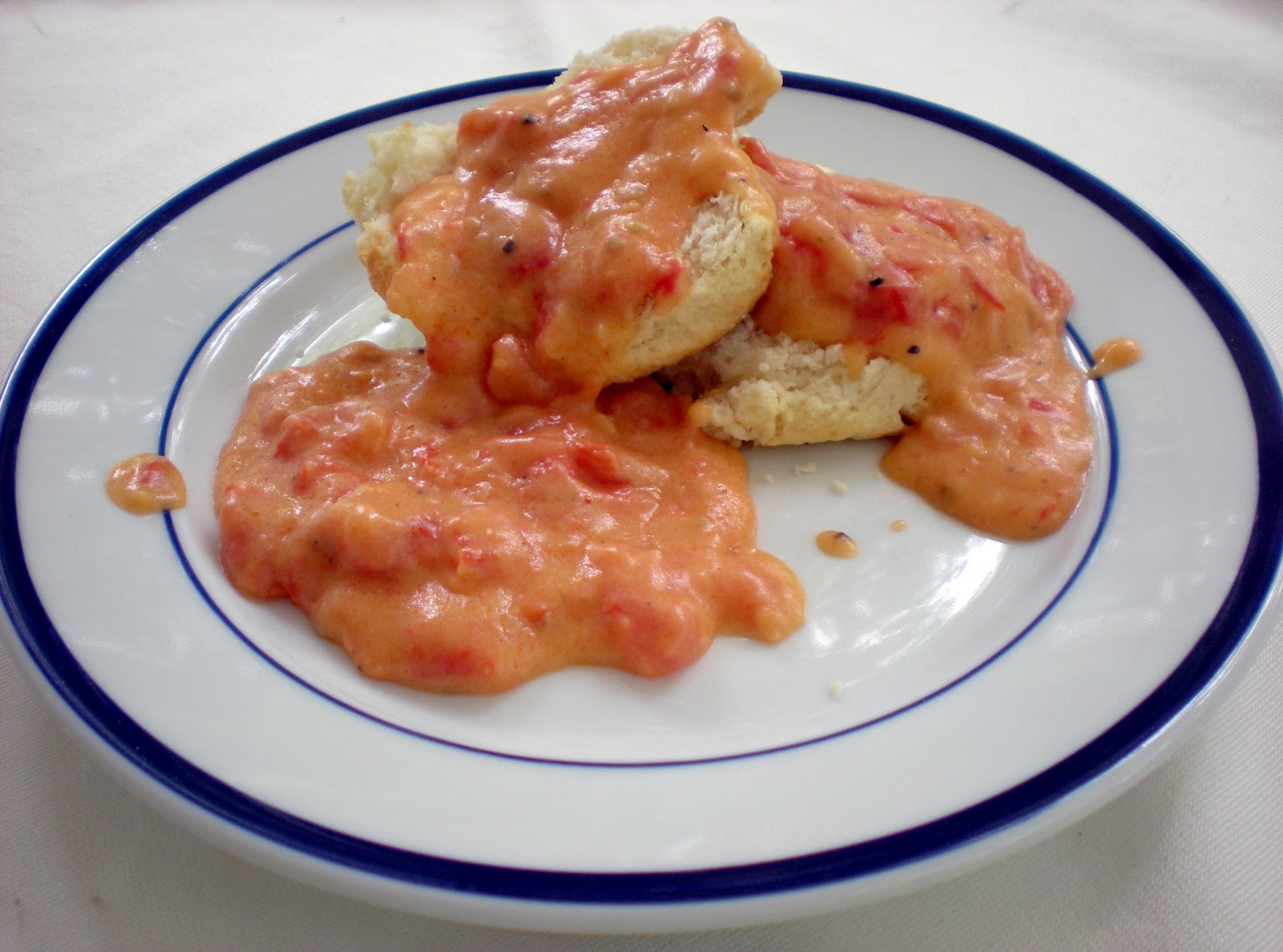
Tomato gravy & biscuits by Lucy Mercer/A Cook and Her Books
Before the tomatoes fade for another summer, do yourself a favor and make tomato gravy and biscuits for yourself and your family. This isn't the kind of "gravy" or "sauce" that you serve with pasta, just a creamy white gravy with chopped tomatoes, cooked up in a cast iron skillet and served over split buttermilk biscuits.
My mother was a fine cook, but I did not grow up with this dish. I discovered it through other cooks and writers. Scott Peacock and Edna Lewis write about it in "Gift of Southern Cooking," and if I remember correctly, serve the gravy with fried chicken.
Cooks can spend a lifetime perfecting their biscuit recipes, and I've tried quite a few, but I always go back to the recipe on the back of the bag of White Lily self-rising flour, using whole fat buttermilk, when I can find it, and brushing the tops of the biscuits with melted butter.
This recipe can be made with bacon fat instead of butter. I usually serve bacon alongside and keep the butter in the gravy.
Farmers' market heirloom tomatoes by Lucy Mercer/A Cook and Her Books
Tomato Gravy
2 tbsp. butter
1/2 cup onion, diced
1 clove garlic, minced
salt and freshly ground pepper
1 tablespoon all-purpose flour
3 ripe tomatoes, peeled, seeded and chopped
1 cup milk
1. In a heavy skillet, melt butter and saute onion until softened. Add garlic, salt and pepper and cook for another minute.
2. Sprinkle the flour over and cook, stirring well for another couple minutes.
3. Stir in the chopped tomato and cook for five more minutes. Slowly add the milk and bring to a simmer. Taste for seasoning, adjust. Serve warm with split buttermilk biscuits and a side of bacon.
Ukrainian Sausage and Tomato Sandwich by Lucy Mercer/A Cook and Her Books
My kids are crazy for this sandwich, a discovery made while researching a social studies project. We found the recipe in an internet search for Ukrainian cuisine and it's been requested again and again. This sausage sandwich is tasty and packs well for office brown-baggers and school lunches. It also features the surprising addition of sliced cucumbers for crunch instead of the usual iceberg lettuce. The original is served open face, but I like having a lid - consider it cook's choice.
Ukrainian Sandwich
1 pound turkey kielbasa, sliced
4 ounces cream cheese
2 ounces butter, softened
2 cloves garlic, minced
Salt and pepper to taste
2 loaves soft French bread
1 cucumber, peeled and sliced thin on the bias
2 Roma tomatoes, sliced thin
1. In a skillet over medium heat, cook sausage slices until they are browned. Remove to a paper towel and drain.
2. In a bowl, mix together cream cheese, butter, minced garlic and salt and pepper to taste.
3. Split baguette in half and spread butter mixture evenly across each half. Layer sausage slices, cucumber and tomatoes then grind more black pepper across top. Place lid on sandwich and press firmly together. Wrap sandwich tightly in plastic wrap. Refrigerate until ready to serve. Slice before serving.
Ratatouille and creamy grits by Lucy Mercer/A Cook and Her Books
I've returned to the kitchen, my source for solace in the late summer. The light through the window is changing, it's amber coming through at a different angle, backlighting the spider web on the porch.
Spider web by Lucy Mercer/A Cook and Her Books
My soul seeks comfort food, but my warm house isn't quite ready for day-long braises and Dutch ovens bubbling over with stewed chicken and bready dumplings. Ratatouille, thick with chunks of eggplant swimming in fresh tomato, I've found, speaks to my soul and lets me walk away from the table without needing a starch-induced nap.
Eggplants by Lucy Mercer/A Cook and Her Books
There are at least two approaches to preparing ratatouille: the one-pot method, where each item is chopped and added to the pan gradually. This yields a tasty, but homogeneous stew. My preferred method requires roasting some of the vegetables, namely the eggplant, to give some textural variety to the final product. My recipe is evolving, first with the boilerplate recipe in the "Gourmet Cookbook," now tweaked by Francis Lam’s primer on Salon.com (previously published at Gourmet.com.) It is, to use Lam’s phrase, so good you’ll want to punch a hole in the wall (but please, don’t, somebody‘s mother will have to fix that.)
Redneck Ratatouille
I tend use whatever quantities of these vegetables I have on hand, given the general guidelines in the recipe. I’ve used roasted Poblano peppers and assorted banana and chili peppers instead of or in addition to the bell peppers. Just be mindful of the heat factor when cooking with the spicy peppers.
2 medium eggplant, peeled and diced into 1-inch pieces
Salt
1/2 cup extra-virgin olive oil
4 large garlic cloves, peeled and smashed
3 large onions, peeled, halved, each half cut into 4 wedges
2 medium zucchini, peeled and diced into 1-inch pieces
2 medium yellow crookneck squash, peeled and diced into 1-inch pieces
4 large tomatoes, cored and chopped
2 tablespoons tomato paste (optional)
2 bell peppers, cored, seeded and cut into 1-inch pieces
A handful of fresh basil
Salt and freshly ground pepper to taste.
1. Eggplant prep: follow this step only if you have the large globe eggplants which tend to be bitter. If cooking with the smaller Asian eggplants, proceed to the next step. Set up a colander over a larger bowl and place eggplant in colander. Pour out about a tablespoon of salt onto the eggplant and toss. Let eggplant drain for about 30 minutes.
2. In a large oven-proof pot, preferably one with a lid, pour in all but about 3 tablespoons of oil and turn heat to medium. Add garlic and onion and bring to a bubbling boil. Let cook for about 30 minutes while you prep the remaining ingredients. Don‘t walk away, because, you know, it‘s a pot of boiling oil.
3. Heat oven to 450 and get out a half-sheet pan or a large cast-iron skillet. Pour eggplant and squash and zucchini out onto the pan (you may need to do this in batches), pour remaining three tablespoons oil and some salt and pepper on the vegetables and set in oven to roast for about 30 minutes. You’re looking for a touch of caramelly brown on the edges of the veg, not blackened.
4. Ok, now we have a pot of boiling oil and alliums on the stove and a pan of roasting squash and aubergine in the oven. It’s time to turn your attention to the tomatoes. In a food processor, puree the tomatoes and peppers. Add to the onion and garlic oil and continue to cook for another 30 minutes. Optional: if using tomato paste, you can add it to the pot with the tomatoes and peppers.
5. When tomato/onion/garlic/oil mixture is a rich red color, add in roasted squash/zuke/eggplant. Taste mixture for seasoning, then add salt, pepper and basil.
6. Turn oven to 300 and set Dutch oven with stew inside. Let ratatouille cook for at least one hour, and several more if you can. Remove pot from oven and let cool.
I serve ratatouille at room temperature over a bowl of creamy grits. Other choices are pasta such as rigatoni, or couscous, or polenta.
There's an old Guy Clark song about home-grown tomatoes that is stuck in my head.
"Homegrown tomatoes, homegrown tomatoes,
What'd life be without homegrown tomatoes?
Only two things that money can't buy -
That's true love & homegrown tomatoes."
Back when the world was young, I was a gardener and like many gardeners, I prayed for summer rains, juicy homegrown tomatoes and raised garden beds. A few years of vegetable gardening on my hands and knees, combined with successive drought years, cured me of these grand illusions and I got a CSA subscription instead. For those who don’t about a CSA (Community Supported Agriculture) subscription, it’s kind of like the best of the farmer’s market packed up just for you each week - including homely home-grown tomatoes - without all the work.
My biggest and best garden was the summer that I was expecting my first daughter and the nesting urge manifested in the garden - I planted 30 pepper plants, 60 tomato plants, countless cucumbers and zucchini, corn, green beans, pumpkins, watermelon. There was just one little problem - my due date was July 21, right at the height of harvest. When friends and family came to our house to visit the baby, we instructed them to go into the garden and take everything they wanted - ripe tomatoes - Big Boy, Better Boy, Green Zebra, cherry tomatoes, yellow pear tomatoes; cukes and zukes as big as Louisville Sluggers; bell peppers; jalapanos; scotch bonnets. Everything went somewhere else - as new parents, we were too discombobulated adjusting to a baby to deal with a vegetable garden, too.
In the intervening years, I've played around with a garden, but not too seriously. Until last year, Georgia was in a severe drought and growing vegetables with water restrictions wasn't really viable. This summer, I’m a gardener again. In a spot by the house that gets full sun and blistering heat, my husband built raised beds in a structure that he calls the Ultimate Garden Tub - three sections, each containing a tub filled with soil, and irrigation to boot. My husband is the kind of guy you can give a box of toothpicks to and he’ll create a scale replica of the Taj Mahal. In the spirit of the second part of the mantra “reduce, reuse, recycle” he took three Harvest Gold hexagonal concrete bathtubs and built a surround for them, adding irrigation and posts for a trellis (that's phase II).
The raised beds limit my seedling-shopping splurges, which is a good thing. Here are the tomato and pepper plants - we’re looking at another few weeks ‘til harvest.
One of the glories of summer tomatoes, homegrown or farmer's market, is using the fruit in a light tomato pasta. Chopped beefsteak tomatoes, creamy Fontina cheese and basil from the herb bed are tossed with warm pasta. One pot and one bowl, light cooking and housekeeping.
Spaghetti with Summer Sauce
I adapted this recipe from a clipping from the Atlanta Journal-Constitution in the summer of 1995, three years before the summer of Laura. I know the year because of the Alka-Seltzer coupon on the back that expired 7-16-95. I used three beefsteak tomatoes in this recipe - they totaled 2 1/4 pounds.
3 large, ripe tomatoes, cut into rough chunks
8 ounces fontina, cubed
½ cup rough-chopped basil, plus more for garnish
3 cloves garlic, minced
½ cup extra-virgin olive oil
1 teaspoon salt
¼ teaspoon freshly ground black pepper
1 pound spaghetti
1 to 2 tablespoons red wine vinegar, or to taste
Freshly grated Parmesan cheese
1. In a large shallow bowl, combine the tomatoes, fontina, basil, garlic, olive oil, salt and pepper. Put this together an hour before you plan to eat and set aside at room temperature.
2. Bring a large pot of salted water to a boil and cook the pasta 8 to 10 minutes, until al dente. Drain the pasta and toss with the sauce. Season with salt, pepper, red wine vinegar and additional basil. Serve at once, sprinkled with grated Parmesan cheese.