Showing posts with label Southern. Show all posts

Thursday, April 5, 2012

The noblest of emulsions

Tie-dye Easter eggs by Lucy Mercer/A Cook and Her Books


This is my contribution to April's #LetsLunch Twitter Party on the theme of eggs. I got a bit mixed up in the Which Came First, the Chicken or the Egg riddle, but there are eggs in here if you have the patience to read it.

When I last wrote about mayonnaise, I described a fish stew with red pepper aioli and my husband's Proustian childhood treat ~ pound cake slices spread with mayonnaise and pan-fried. At the time, my new foodie friend Pedro commented "mayonnaise is the noblest of all emulsions!"

Two years later, I still consider that a great comment because it touches on how Southerners feel about the French-by-way-of-Spain sauce. It's omnipresent, particularly in the sandwich realm. It's the glue that keeps my minner cheese together, the binder for the tartar sauce that augments our Friday fish fry, the finishing touch to my lunchtime ham and cheese sandwich.

Mayonnaise wasn't always the ubiquitous sandwich spread. Time was, another egg-based spread was whipped up for sandwich- and salad-making, boiled dressing. This old-fashioned sauce is similar to mayonnaise - it uses egg yolks and a tiny bit of mustard for flavor and thickening, but whereas mayo relies on oil and a prayer to emulsify, boiled dressing adds flour and cream, caressed with a finishing swirl of butter. Mayonnaise is only slightly acidic, but boiled dressing will pucker your mouth with the tang of cider vinegar.

If mayonnaise is the noblest of emulsions, then boiled dressing is the tarted-up, some might say eccentric, Aunt Flossie brought out for non-public family occasions. Non-public, because by today's standards, it's really a bit of trouble and yields a small quantity. And family because, this is secret recipe kind of stuff, the kind of sauce on which legends and maybe fortunes can be made.

Boiled dressing is properly made in a double boiler, and it's sometimes called cooked dressing. As in Cole Slaw with Cooked Dressing, or Potato Salad with Cooked Dressing. I prefer boiled dressing on that staple of the Steel Magnolia circuit, chicken salad.

Easter eggs. Lucy Mercer/A Cook and Her Books


Forgive the tangentially-interesting pictures of the Easter eggs. We decorated 10 dozen Easter eggs, that's a lot of vinegar and color tabs, don't you think? Back to the subject at hand: eggs and chicken salad:


Southern boiled dressing. Lucy Mercer/A Cook and Her Books


You use only white meat on your chicken salad, right? You know the girls in Junior League will talk behind your back in you put dark meat in your chicken salad. Just kidding. Here's how I poach chicken for chicken salad:

Poached chicken breasts

3 boneless, skinless chicken breasts, about a pound and a half

Juice of half a lemon

1/2 teaspoon salt

A few grinds of coarse black pepper

Water

1. In a skillet with a lid, set over medium heat, place chicken breasts and just barely cover with water. Add salt, lemon juice, and fresh ground black pepper. Let water come to a boil. Cover with lid, set heat to low and cook for 15 minutes. After 15 minutes, use a fork and knife to determine doneness of the meat. If meat is still pink, cover and cook for an additional 5 minutes. Repeat as necessary until meat is cooked through.

2. Remove chicken breasts from broth (which may be saved for another purpose). Let cool enough to handle comfortably. Chop into smallish bites for chicken salad. And here's something I like to do before I mix together the chicken salad: I sprinkle a teaspoon or two of good-quality red wine vinegar over the chicken, and maybe a 1/4 teaspoon salt, just a tetch.


Favorite tip for bringing refrigerator-cold eggs to room temp: place in bowl of warm water. Lucy Mercer/A Cook and Her Books.


 Old-fashioned Boiled Dressing

1 teaspoon dry mustard

2 teaspoons sugar

1/2 teaspoon salt

2 tablespoons flour

1/2 cup water

2 egg yolks, beaten

3 tablespoons apple cider vinegar

3 tablespoons butter

3 tablespoons heavy cream

1. Place a double boiler on stovetop over medium heat. Fill bottom with enough water to just touch the bottom of inset. Let water come to a gentle boil.

2. Add dry ingredients into top of double boiler, whisk to break up lumps. Gradually whisk in water.

3. Add the egg yolks and vinegar and continue stirring. Let cook for at least five minutes, continually cooking. When mixture is thick, remove from heat and stir in butter, then cream. Season to taste, adding salt and pepper as needed. Ladylike cooks will add white pepper so as not detract from the creamy yellow sauce. I think white pepper tastes like soap, so I leave it out.

4. Let sauce come to room temperature. Use immediately in a recipe or store in a tightly covered jar in the refrigerator for up to 3 days.


Chicken salad on croissants. Lucy Mercer/A Cook and Her Books
 My Chicken Salad


3 boneless chicken breasts poached according to recipe above, or 2 cups chopped, cooked chicken


2 stalks celery, chopped fine


2 green onions, chopped


1 recipe Boiled Dressing from above recipe


1/2 to 1 cup mayonnaise or sour cream, depending on your preference


1/2 cup chopped pecans

Salt and pepper to taste


1. Toss together chicken, celery and onions. Add boiled dressing and taste. Add mayonnaise or sour cream, stir together, then taste. Adjust seasonings and dressing. Stir in chopped pecans. Serve.


For more egg-citing recipes, check out these #LetsLunch posts: 

- Cheryl‘s Singapore-Style Chai Poh Scramble at A Tiger in the Kitchen

– Charissa‘s Gluten-Free Leek, Ham & Pecorino Souffles at Zest Bakery

– Denise‘s Beet Dye & Pink Deviled Eggs at Chez Us

– Emma‘s Eggs In A Hole at Dreaming of Pots & Pans

– Felicia‘s Perfect Sandwich at Burnt-Out Baker

– Grace‘s Scrambled Eggs & Tomatoes at HapaMama

– Joe‘s Kim-Chi Deviled Eggs at Joe Yonan

– Linda‘s Home-made Cadbury Eggs (Maple Chocolate Eggs) at Free Range Cookies

– Lisa‘s Legendary Egg & Onion at Monday Morning Cooking Club


– Rashda‘s Bombay Toasts (Spicy French Toasts) at Hot Curries And Cold Beer

– Vivian‘s Oeuf Chaud Froid at Vivian Pei


Sunday, July 24, 2011

Pimento Cheese is the new gravy

Pimento cheese and crackers by Lucy Mercer/A Cook and Her Books


As we approach the real dog days of summer, I can confess that it's been so long since I've really cooked! We eat so simply in the summer; I've come to the conclusion that my perfect summer meal is homemade pimento cheese on crackers; crispy, sweet watermelon slices, and iced tea. I could eat this for breakfast, lunch or dinner (and another confession: I have).

Have you seen all the buzz about pimento cheese (or, as it's known in my house, minner cheese)?  Wanda at The Teacher Cooks blog features a minner cheese biscuits recipe that I can't wait to try. There's even a tweet-bot on @pimentocheese, professing a love of the cheese spread all through the Twitter-verse. I never had homemade pimento cheese until I married; my family knew only the occasional plastic container of gloppy fluorescent orange spread. I had to ask my mother-in-law to make minner, and naturally, it's the easiest thing in the world: coarsely shredded sharp Cheddar cheese, diced pimentos, mayonnaise, and a pinch of salt (depending on the sodium in the mayo and cheese, you may leave this out).

Pimento Cheese


8 ounces sharp Cheddar cheese

1 cup mayonnaise, approximately, (I've never bothered to measure)

Pinch of salt

2 tablespoons chopped pimentos

1. Shred Cheddar cheese on the coarse side of a hand grater or in a food processor.

2. In a bowl, stir together cheese and enough mayonnaise to bind. Add salt and pimentos. Serve with crackers or on squishy white bread.

Wednesday, April 6, 2011

A Southern Favorite: Buttermilk Chess Pie


Buttermilk Chess Pie by Lucy Mercer/A Cook and Her Books

Pie is the new cupcake. Did you know that? That's why I've spent the last month turning out my favorite pies for my family -  from Pie Lab's Apple Cheddar Pie to my favorite Sweet Potato Custard Pie - it's so nice to be able to announce that there is pie for dessert. Here's a buttermilk chess pie that I love, and each time I make it, I think of that Southern tradition of drinking buttermilk, a drink I'm convinced you have to be raised on to appreciate.

My last quarter at the University of Georgia in Athens, I rented a room in an elderly woman's house. Mrs. Willson was a widow and her only daughter lived in Columbus. This was, sigh, more than a couple years ago, and only a few memories rise to the surface - her red brick ranch house with the laundry room off the carport, the old-fashioned medicine cabinet with a slot for dull razor blades, and the refrigerator that she allowed her boarders to share, giving us each our own corner of a shelf. She hid her beer in the back of the fridge, small baby bottles behind the mayonnaise and pickle jars. Mrs. Willson also liked buttermilk and cookies as an evening snack. I always accepted the Grandma's oatmeal cookies, but declined the buttermilk.

To this day, I keep buttermilk in the fridge, but never for drinking straight. It's the base for ranch dressing, with the fresh herbs from the CSA box; it makes a moist banana bread; superlative biscuits (if you use White Lily flour); and this thoroughly excellent Chess Pie.

This is one of the first pies I made. As a new bride, I subscribed to Southern Living magazine for the recipes and the decorating ideas. My husband picked up an issue and remarked that he always liked chess pie. He says nice things about this pie, so I've kept it in my tried and true file. I've cut the sugar by one-fourth, but it's still very sweet. Take your coffee black with a slice of this pie.


Buttermilk Chess Pie by Lucy Mercer/A Cook and Her Books

Buttermilk Chess Pie

1 1/2 cups sugar

2 tablespoons all-purpose flour

5 large eggs, lightly beaten

2/3 cup buttermilk

1/2 cup unsalted butter, melted

1 teaspoon vanilla

1 unbaked 9-inch pie crust

1. Preheat oven to 350.

2. Combine sugar and flour in a large bowl. Add eggs and buttermilk, stirring until blended. Stir in melted butter and vanila and pour into unbaked pie crust.

3. Bake at 350 for 45 minutes or until set. Cool on a wire rack at least an hour before serving. Store leftovers, well-wrapped in refrigerator.

Text and images copyright 2011, Lucy Mercer.

Thursday, March 3, 2011

Luscious Lemon Cream Cheese Pound Cake (for National Pound Cake Day)

Lemon cream cheese pound cake. Lucy Mercer/A Cook and Her Books


I'm not sure how or why there is a National Pound Cake Day, but here it is the 4th day of March, in the holiday lull between St. Valentine's and St. Patrick's Day and I guess somebody needed an excuse to bake. Pound cake is as good an excuse as any, I suppose.

The classic pound cake requires a pound of each ingredient - butter to sugar to flour to eggs. Without leavening, this makes for a large, dense cake. Modern cakes tend to fudge on the ratio. My go-to recipe has a ratio of approximately 1.25 pounds fat (combined cream cheese and butter) : .75 pound sugar : .75 pound flour : .6 pound eggs.

Looking for a new flavor, I dug out a cookbook that has hugged my pantry shelf for at least 15 years - "The Pound Cake Cookbook" by Bibb Jordan (Longstreet Press, 1994). It's a darling little book, cover price $8.95, with nearly 40 recipes from Chocolate Cherry Pound Cake to Savory Cheese Pound Cake. My eyes locked on "Lemon Cream Cheese Pound Cake" - I'm a sucker for anything with lemon - lemon cookies, lemon curd, lemon meringue pie, lemon bars.

This recipe is surprising, first with the self-rising flour. Pound cakes are traditionally leavened only with eggs, which can make for a leaden leaven. I personally like a dense texture, but this lighter cake is a winner, too. Because of the leavening, it bakes faster, in under an hour, and has a lighter, spongier texture. It’s perfect for a spring dessert. With Easter and Mother’s Day falling within two weeks of each other, this would make an excellent cake for the holiday table. The cake is pretty with a dusting of confectioner’s sugar, but I like the puckery tart sweetness of the lemon glaze.


Lemons by Lucy Mercer/A Cook and Her Books


Lemon Cream Cheese Pound Cake with Lemon Glaze


Adapted from The Pound Cake Cookbook by Bibb Jordan (Longstreet Press, 1994)


3 medium lemons, zested and juiced

1 cup (2 sticks) unsalted butter, at room temperature

8 ounces 1/3-less-fat (Neufchatel) cream cheese, at room temperature

2 cups sugar

6 large eggs, at room temperature

2 cups self-rising flour

1 teaspoon lemon extract

1. Preheat oven to 325. Prepare a tube or Bundt pan with baking spray or butter and flour.

2. In large mixing bowl, using an electric mixer, cream together the butter and cream cheese. Gradually add sugar. Add eggs two at a time, beating well after each addition.

3. Add flour, lemon zest, lemon extract and two tablespoons of lemon juice (reserve remainder of juice for lemon glaze), beating until flour is incorporated and batter is smooth and free of lumps.

4. Pour into prepared pan. Bake for 45 to 50 minutes at 325. Cake is done when tester comes out clean. Let cool on wire rack. While cake is cooling, prepare the Lemon Glaze.

Lemon Glaze

2 tablespoons freshly squeezed lemon juice

1 to 1 ½ cups confectioner’s sugar

1. In a medium bowl, combine lemon juice and confectioner’s sugar. Whisk until combined and lump-free. If the glaze is lumpy, whisk vigorously, then let sit for 10 minutes or so, the lumps will be absorbed.

2. Glaze lemon pound cake while still warm.

My little kitchen helper wanted to decorate the cake, and she just happened to have a box of Valentine hearts....

Lemon Pound Cake with Valentines by Lucy Mercer/A Cook and Her Books
The artist and her creation. Lucy Mercer/A Cook and Her Books

Happy National Pound Cake Day! Don't forget to leave cake for the elves!
 
Text and images copyright 2011, Lucy Mercer.

Tuesday, March 1, 2011

Chef Joe Truex offers milk and cookies, thoughts on Southern cuisine

Chef Joe Truex of Watershed in Decatury by Lucy Mercer/A Cook and Her Books


Joe Truex believes in terroir, as a chef, wine connoisseur and a native Southerner. That’s how Truex, the chef at Watershed in Decatur, Georgia, explains the enduring national appeal of Southern cuisine. The Louisiana native spoke recently at the American Culinary Federation’s Southeastern conference at the Hilton Atlanta. In describing what makes Southern cuisine both elusive and enduring, Truex told the audience of culinary students and professional chefs that geography and provenance make a difference.

“The South is steeped in tradition,” he said. “As a chef, it’s my responsibility to explore that, to find products and techniques that are new and interesting.”

Truex feels strongly about sourcing ingredients that taste great, and also to accommodate customers with special needs, such as those with celiac disease or gluten intolerance. He uses rice flour from Anson Mills to reduce the amount of gluten in sweets like the Charleston Scotch Cake that he served the audience. The buttery cookie, very much like a shortbread, was sandy and crisp, lighter than a typical shortbread. Truex served it with horchata made from Carolina Gold Rice and almonds; a chef’s take on milk and cookies.

Truex called on the professionals and students in the room to creatively explore Southern cuisine. “The South needs to define itself and further, and at the same time, it needs to expand.” By using heritage ingredients, or ingredients from another cuisine, Truex hopes to “take something old and familiar and make it new and exciting.”

Watershed Restaurant is a Decatur institution, and in Truex's words, "an icon of Southern dining." Founded by the Indigo Girls' Emily Saliers and chef Scott Peacock, its loyal following expects fried chicken on Tuesdays and Southern-cooked vegetables every day of the week. Chef Peacock, who wrote the book "The Gift of Southern Cooking" with his friend and collaborator, the legendary Edna Lewis, left the restaurant last year to pursue new projects. The personable Truex brings to the plate the same sourced-from-the-heart mentality as Peacock, and has plans to put his own stamp on the restaurant's menu, even if that means shaking things up a little bit, (and, even if that means taking the vegetable plate off the menu - loyal fans, don't say I didn't warn you.)


Shortbread by Lucy Mercer/A Cook and Her Books


Charleston Scotch Cake (Shortbread)
from Anson Mills
This is the cookie that Truex served at the conference. It is light and crispy and buttery.

1 1/2 cups unbleached all-purpose flour

1/2 cup Anson Mills Carolina Gold Rice Flour

1/2 cup plus 1 tablespoon superfine sugar

1/2 teaspoon fine sea salt

5 ounces (10 tablespoons) cold, unsalted European-style butter, cut into pieces


1. Adjust the oven racks to the lower and upper third positions and heat the oven to 325 degrees. Turn the flours, 1/2 cup sugar, and salt into a food processor bowl and pulse to combine.

2. Distribute the butter over the dry ingredients in the food processor and pulse until the mixture resembles coarse meal. Run the processor without pulsing until the dough is very fine, about 10 seconds more. Turn the dough into an ungreased 9-inch cake pan and press down firmly and evenly with a small offset spatula or the back of a spoon. Place the pan on the lower oven rack and bake for 20 minutes.

3. Remove the pan from the oven. Working quickly, score the shortbread into 16 wedges with a sharp, thin knife, then pierce a design into each wedge with a wooden skewer. (Don't cut or pierce the dough completely through.) Return the pan to the oven and bake the shortbread on the lower rack 10 minutes more. Transfer the pan to the upper oven rack and continue baking until the shortbread is toasty brown, 30 to 40 minutes longer. Remove from the oven and place the pan on a wire rack. Sprinkle the shortbread with 1 tablespoon sugar and cut gently through the score marks with a sharp knife while the shortbread is still in the pan. Let cool completely. Remove the wedges from the pan with a small offset spatula. The shortbread will keep well wrapped for up to 2 weeks at room temperature.

My Lighter, Crispier Scottish Shortbread

This is my standard shortbread recipe, with 1/2 cup rice flour subbing for some of the unbleached a-p flour. The fleur de sel doesn't fully melt in the shortbread, giving small dabs of salty goodness throughout - kind of a grown-up taste, so you may want to go with table salt if you're feeding kids.

16 tablespoons unsalted butter, slightly softened

½ cup powder sugar (10X)

1 1/2 cups unbleached all-purpose flour

1/2 cup rice flour (I used Bob's Red Mill)

¼ teaspoon salt, or fleur de sel, if you have it

1 teaspoon vanilla extract


1. Preheat oven to 325. In a mixer, cream butter and sugar. Gradually add flour and rice flour. Add salt and vanilla.

2. Line a rimmed baking sheet with a Silpat or parchment paper. Using a rolling pin, gently roll out the dough to 1/4 –inch thick, into 12-by-6-inch rectangle. Using a sharp knife, cut into 1-by-3-inch rectangles and place on baking sheet. Use a fork to dock the dough in a decorate fashion.

3. Bake at 325 for 20 minutes or until golden brown. Remove from oven and let cool. Store in an airtight container at room temperature. Enjoy with a cup of tea, or horchata, and a good book, like "Gift of Southern Cooking."

Text and images copyright 2011, Lucy Mercer, with the exception of Anson Mills' shortbread recipe and photo of Joe Truex.


Sunday, January 30, 2011

I want candy (bacon)

Candied bacon by Lucy Mercer/A Cook and Her Books
Breakfast during the week is usually a filling bowl of oatmeal, or maybe vanilla yogurt with my homemade granola, some mornings a whole wheat bagel with a shmear. On the weekends, though, I'll put together a bigger breakfast, and have it ready for my sleepyheads when they wander downstairs. Crispy, yeast-raised waffles, or buttermilk pancakes, sometimes with ham, sometimes with this decadent bacon, baked in the oven with brown sugar. This is the sinful salt, sugar and bacon fat matrix - you can't stop at just one piece, so save it for a sometimes treat for your family.

I gave up frying bacon on the stovetop a long time ago. I bake it in the oven now and I have a system that guarantees easy clean-up and crispy bacon.

Candied Bacon
1 pound thick-cut bacon (I use Oscar Mayer hearty thick cut, but other brands will work)

2 tablespoons brown sugar (light or dark will work, I favor dark)

Cayenne pepper, optional

1. Preheat the oven to 350. Take a half-sheet pan or rimmed baking sheet and cover it with foil, making sure to push the edges of the foil against the sides of the pan. Place a nonstick baking grid on top of the foil (if you don't have one, it's ok, but the baking grid will keep the bacon out of the grease).

2. Place the strips of bacon on the baking grid. Sprinkle the strips with brown sugar and a bit of cayenne, if using. Bake at 350 for 25 to 30 minutes, or until desired level of crispiness is reached. Remove from oven and drain on paper towels.


Text and images copyright 2011, Lucy Mercer.

Sunday, December 26, 2010

Not my mama's black eyed peas & greens

Black eyed peas with Indian spices. Lucy Mercer/A Cook and Her Books


Visit my mom’s house on New Year’s Day and you will be treated to simple, humble fare – a black-as-midnight cast iron skillet sizzling with buttermilk cornbread, a pot of black-eyed peas and a bowl of greens, usually collards. The peas and greens are usually cooked with pork, such as the leftover bone from the Thanksgiving ham. And if you’re lucky, there will be a jar of  chow-chow from a friend’s summer canning frenzy; the relish makes a fine garnish for the black-eyed peas.

It’s kind of endemic to the Southern experience that the Way Mom (or Grandma) Cooks is the best and only way to cook. My mother is an excellent cook and I’ve learned much in her kitchen. At my mother’s apron strings, I learned dishes such as country fried steak and chicken & dumplings. I learned to make layer cakes, pound cakes and cookies. My mom taught me how to put together a meal, cooking the meat and vegetables in order so that everything is ready at the same time. She taught me her way, but she also taught me something else: to try new things. This is the most valuable lesson of all. Even in my suburban Georgia neighborhood, I have an incredible amount of ingredients and technology available to me, plus a world of information at my fingertips. I can choose to cook from my own little world or I can bring the world into my kitchen.

Which is why on New Year’s Day 2011, you will find the traditional black eyed peas flavored with garam masala, turmeric and cumin at my table. This recipe is adapted from Gene Lee, who writes for the Atlanta Journal-Constitution and blogs at Eat, Drink, Man: a Food Journal. Instead of cooking the peas entirely on the stovetop, I start them off in a Dutch oven and place it in the oven on convection for an hour or more, for the peas to slowly soak up the spicy goodness.


Oven-Braised Black Eyed Peas with Indian Spices

A note on the chilies: the original recipe specifies three to six chilies. In the summer, I take the chilies and peppers from the CSA box, roast them together, seed them and freeze in a container. Whenever I need peppers or chilies, I break off a portion and use in the recipe. When making this recipe, I used about 1/2 cup of chopped, frozen chilies. 

8 ounces dried black-eyed peas
4 tablespoons olive oil
2 teaspoons whole cumin seeds
4 cloves garlic, minced
1-inch piece of ginger, peeled and minced
2 chilies, chopped
1 medium onion, peeled and chopped into ¼ inch dice
 1 teaspoon salt
¼ teaspoon cayenne pepper, or to taste
¼ teaspoon turmeric
½ teaspoon garam masala
2 cups water

1.      Pour peas onto a rimmed half sheet baking pan and pick out stones, debris and off-looking peas. Pour peas into a bowl and cover with water. Swish the peas, then pour off most of the water. Refill with water to cover peas by one inch and leave to soak for a few hours or overnight. Add water, if needed.
2.      When ready to cook, put a Dutch oven on the cooktop over medium heat and pour in oil. Add cumin seeds, garlic and ginger and stir for a minute. Add dry seasonings – salt, cayenne, turmeric and garam masala. Cook over medium heat for five minutes. If mixture is too dry, add a spoonful of water. Turn up the heat and add onions and chilies.
3.      Add peas and water and bring to a boil. Heat oven to 350. Place Dutch oven in real oven at 300 for at least one hour. Check liquid level occasionally. Peas should be done after an hour, but can continue to cook at low heat for several hours - be sure to check the liquid level and replenish with water as needed.

Beets and beet greens. Lucy Mercer/A Cook and Her Books
     

  I’ve also tried a new method for cooking greens. I happen to think collards are great and consider the work involved – washing, trimming and chopping – a labor of love. But my family? Not so much. My  friend Susan’s recipe for Kale with Raisins and Pine Nuts has turned my husband and girls into greens eaters. Susan writes about produce on her blog, Thoughtful Consumption. Here is my adaptation of her recipe.

Kale and Beet Greens with raisins and pine nuts

There are many possible variations of this dish – any kind of green except for collards would work. (As much as I love collards, they’re just too tough for this quick treatment.). I used a bunch of kale plus some beet greens and it was terrific. Slivered almonds or roughly chopped walnuts could sub for the pine nuts.

2 tablespoons olive oil
¼ cup pine nuts
¼ cup raisins
1 bunch of greens such as kale or beet greens, or a combination of greens, washed and trimmed into 2-inch pieces
Salt and pepper to taste

1.  In a skillet over medium heat, pour in olive oil. Add pine nuts and raisins, stirring and cooking until pine nuts are golden and raisins are plump and soft.
2. Add greens, stirring until softened, at least five minutes, or as much as 10. If they dry out, add a bit of water a spoonful at a time. Season with salt and pepper and serve.

Greens with pine nuts and raisins. Lucy Mercer/A Cook and Her Books

I'm not saying that these two dishes should be served together, but either one would make a fine addition to a New Year's feast. Just be sure to add the cornbread, a dish so perfect that there's no point messing with it.

Cornbread. Lucy Mercer/A Cook and Her Books

I submitted this story for a Twitter party called Let's Lunch. Here are a few other stories on the theme Holiday Sides by some awesome writers. Be sure to check them out! (and if you'd like to be a part of Let's Lunch, go to Twitter and post a message with the hashtag #LetsLunch!

Cheryl Tan's Auntie Jane's Potato Gratin at Cheryl Lu-Lien Tan
Charissa‘s Coconut Date Balls at Zest Bakery
Eleanor‘s Easy Festive Stir-Fry at Wok Star
Ellise‘s Lime-Chipotle Carrots at Cowgirl Chef
Felicia‘s Chinese Butterfly Cookies at Burnt-Out Baker
Grace‘s Fruitcake at HapaMama
Joe‘s Maine Homestead Holiday Dishes at Joe Yonan
Linda‘s Baked Salad at Free Range Cookies
Linda‘s Trinidadian Baked Pastelles at Spicebox Travels
Lisa‘s Potato Latkes at Monday Morning Cooking Club
Lucy‘s “Not My Mama’s” Black-Eyed Peas & Greens at A Cook And Her Books
Maria‘s Grandma Dorothy’s Deviled Eggs at Maria’s Good Things
Patrick‘s Baby Pecan Pies at Patrick G. Lee
Rebecca‘s Grandmother Martha’s Potato Kugel at Grongar Blog
Steff‘s Sweet Potato Casserole with Pecan Crumble at The Kitchen Trials
Victor‘s Roasted Parsnips, Carrots & Delicata Squash Tossed With Sauteed Mustard Greens at The Taste of Oregon

Text and images copyright 2010, Lucy Mercer.

Friday, December 3, 2010

Favorite Southern Christmas cookies


“Oh Buddy, I think it’s fruitcake weather,” goes the opening line to one of the best short stories ever written (and certainly a sentimental Southern favorite), “A Christmas Memory” by Truman Capote. Capote based the story on his own memories with his elderly cousin Sook, his eccentric best friend, who baked fruitcakes each Christmas and sent them to acquaintances and people they admired, including Mr. and Mrs. Roosevelt at the White House.

These days, the idea of fruitcake is as stale a joke as some of the cakes that remain on the bottom shelf of the Frigidaire from last Christmas. The main appeal of fruitcake for me is the candied cherries, the red and green chewy bits of sugary former fruit. Although a candied cherry is as similar to a real cherry as plastic-encased American cheese is to aged Manchego, they still hold a visual and sentimental appeal.

Fruitcake is not a tradition in my home, although my mom makes stellar "fruitcake cookies." (That recipe is hers and I hope to share it soon). I buy the candied cherries, however, to top Mom’s sandy, crispy, buttery shortbread. Shortbread is the easiest, most elemental cookie – butter, confectioner’s sugar, flour, salt and vanilla. When I wake up in early December and say “it’s cookie baking time,” I always start with a tray of shortbread. Like Sook and Buddy's fruitcake, it’s a tradition, and it’s simple – I already have butter, sugar and flour out and the oven’s pre-heating.


Scottish Shortbread


1 cup unsalted butter, slightly softened

½ cup powder sugar (10X)

2 cups unbleached all-purpose flour

¼ teaspoon salt

1 teaspoon vanilla

Candied cherries or pecan halves for garnish, if desired

1. Preheat oven to 325. In a mixer, cream butter and sugar, then add flour gradually. Add salt and vanilla.

2. Line a rimmed baking sheet with a Silpat or parchment paper. Using a rolling pin, gently roll out the dough to 1/4 –inch thick, in a rough rectangle. Using a sharp knife, cut into 1-inch square pieces. Press cherry or pecan halves onto each square.

3. Bake at 325 for 20 minutes or until golden brown. Remove from oven and let cool. The cuts will have melded back together, but quick work with a sharp knife will take care of that. Store in an airtight container at room temperature.


There are traditions to keep and traditions to make your own, like pecan tassies. This is a Southern sweet - tassie is a Scots variation of “cup” and a pecan tassie is a small cup of pecan pie filling, a tasty two-biter, rich and sweet. I make tassies each December with Georgia pecans, and they occupy a coveted corner on my cookie plates, but this year, I decided to part with tradition and use macadamias. You know the part of “Christmas Memory” where the fruitcakes are done and Sook gives Buddy and Queenie (the dog) some of Mr. Haha Jones’ whiskey and they dance in the kitchen and feel the Christmas spirit? Well, if I’ve learned anything this year, it’s to take the recipe as a suggestion, drink the whiskey and dance in the kitchen.

Macadamia-Rum Tassies


If you can’t get past the idea of messing with traditional Pecan Tassies, just sub pecans for the macadamias and vanilla for the rum (and tell your friends the recipe came from your cousin Sook.)

Pastry

1 3-oz package cream cheese

½ cup unsalted butter

1 cup unbleached all-purpose flour

Filling

1 egg

¾ cup packed dark brown sugar

1 tablespoon unsalted butter, melted

1 teaspoon rum

2/3 cup chopped macadamia nuts

1. Combine cream cheese, butter and flour in mixing bowl. Form into a ball, wrap in plastic wrap and chill in refrigerator for one hour. After one hour, remove from refrigerator and shape into 22 balls. As much as I want this recipe to make 24, I’ve never managed to get the dough to stretch that far. Press each ball into a cup of a mini-muffin pan.

2. Preheat oven to 325. For filling, beat egg with brown sugar, add melted butter, rum and macadamias. Pour into shells, just a spoonful in each because they puff when they bake. Bake at 325 for 25 minutes. Remove from oven and let cool. Store in a covered container at room temperature.

Text & images copyright 2010, Lucy Mercer.
<script type="text/javascript">
  var _gaq = _gaq || [];
  _gaq.push(['_setAccount', 'UA-21764820-1']);
  _gaq.push(['_trackPageview']);

  (function() {
    var ga = document.createElement('script'); ga.type = 'text/javascript'; ga.async = true;
    ga.src = ('https:' == document.location.protocol ? 'https://ssl' : 'http://www') + '.google-analytics.com/ga.js';
    var s = document.getElementsByTagName('script')[0]; s.parentNode.insertBefore(ga, s);
  })();

</script>

Tuesday, September 28, 2010

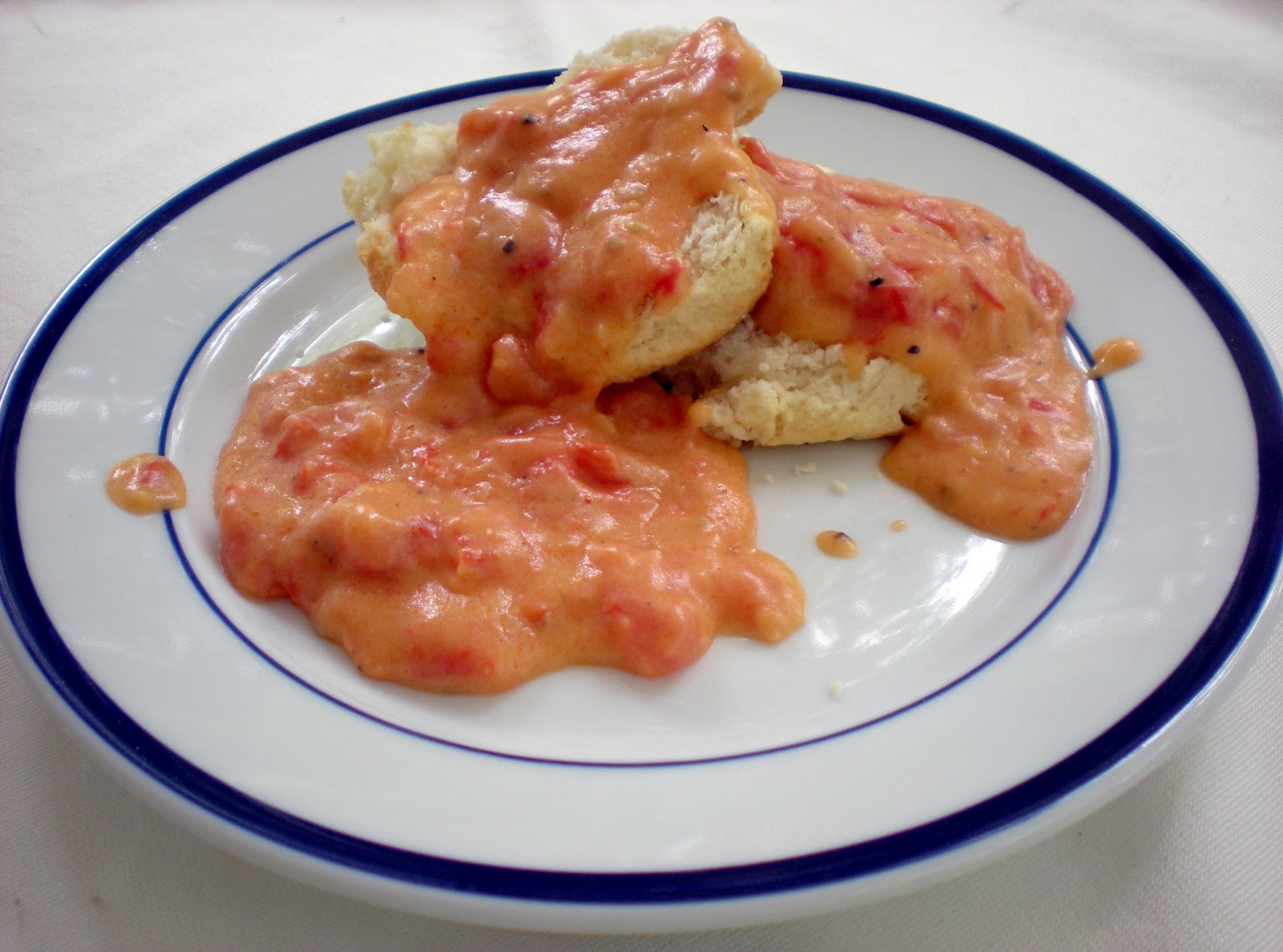
Tomato Gravy & Biscuits


Tomato gravy & biscuits by Lucy Mercer/A Cook and Her Books


 Before the tomatoes fade for another summer, do yourself a favor and make tomato gravy and biscuits for yourself and your family. This isn't the kind of "gravy" or "sauce" that you serve with pasta, just a creamy white gravy with chopped tomatoes, cooked up in a cast iron skillet and served over split buttermilk biscuits. 

My mother was a fine cook, but I did not grow up with this dish. I discovered it through other cooks and writers. Scott Peacock and Edna Lewis write about it in "Gift of Southern Cooking," and if I remember correctly, serve the gravy with fried chicken.
Cooks can spend a lifetime perfecting their biscuit recipes, and I've tried quite a few, but I always go back to the recipe on the back of the bag of White Lily self-rising flour, using whole fat buttermilk, when I can find it, and brushing the tops of the biscuits with melted butter.
This recipe can be made with bacon fat instead of butter. I usually serve bacon alongside and keep the butter in the gravy. 

Farmers' market heirloom tomatoes by Lucy Mercer/A Cook and Her Books
Tomato Gravy

2 tbsp. butter
1/2 cup onion, diced
1 clove garlic, minced
salt and freshly ground pepper
1 tablespoon all-purpose flour
3 ripe tomatoes, peeled, seeded and chopped
1 cup milk
1. In a heavy skillet, melt butter and saute onion until softened. Add garlic, salt and pepper and cook for another minute.

2. Sprinkle the flour over and cook, stirring well for another couple minutes.

3. Stir in the chopped tomato and cook for five more minutes. Slowly add the milk and bring to a simmer. Taste for seasoning, adjust. Serve warm with split buttermilk biscuits and a side of bacon.

Text & images copyright 2010, Lucy Mercer.

Wednesday, August 11, 2010

Creamy Grits are a Satisfying Go-With


Creamy Grits by Lucy Mercer/A Cook and Her Books
 Let's be clear: I was born in the South, I live in the South, and I will love grits 'til my dying day. Growing up, quick white grits with a puddle of butter were a Sunday morning treat alongside scrambled eggs and bacon. My husband introduced me to his ritual of crumbling bacon into the grits for a salty, smoky crunch.

Before the girls came along, I would come home some nights, dead tired from work, put on jammies and fix a bowl of grits, sprinkle them with shredded Cheddar cheese and eat them in front of Thursday night's Must-See-TV. These days, I still turn out grits for breakfast, but I've expanded my options and use grits the way Italian cooks use polenta - as a foil for rich stews such as ratatouille.

Here's my recipe for creamy grits. You can use regular quick grits (never instant!), or the sunny yellow grits made by Dixie Lily.

Creamy grits

2 cups water

1 cup chicken broth

1 cup milk

1 cup grits

Salt and freshly ground pepper to taste

Cheddar cheese, cream cheese, butter and other goodies, p.r.n.


1. In a medium saucepan, preferably nonstick, combine all liquids and place over medium heat. Slowly whisk in grits. Bring to a simmer, whisking occasionally, and cook until the grits are smooth and free of lumps.

2. Stir in cheese, if using, and butter and seasonings. Serve with breakfast or as a base for ratatouille.


Monday, July 5, 2010

Aubergine: Eggplant by Another Name

Aubergine, or eggplant by Lucy Mercer/A Cook and Her Books


If soft, luxurious silk were a food, it would be eggplant. Maybe not just eggplant, but aubergine. American English can be harsh to the ear; I like the way the Brits use the French aubergine, it even sounds silky. Like silk, the regal eggplant, which is botanically classified as a fruit, is classic in many cuisines: The French have ratatouille, the Italians have Parmigiana, the Greeks have moussaka.

Of course, I can't think of eggplants without remembering the charming writer Laurie Colwin, who wrote an essay entitled "Alone in the Kitchen with an Eggplant" nearly 25 years ago. In "Home Cooking," her collection of essays, many of which appeared first in Gourmet magazine, in between "The Low-Tech Person's Batterie de Cuisine"and "How to Fry Chicken," she extols the versatility of eggplant and how she cooked it in her Greenwich Village apartment "approximately the size of the Columbia Encyclopedia." She did this without a kitchen, just a two-burner hot plate.


"When I was alone, I lived on eggplant, the stove top cook's strongest ally. I fried it and stewed it, and ate it crisp and sludgy, hot and cold. It was cheap and filling and was delicious in all manner of strange combinations. If any was left over, I ate it cold the next day on bread."

She goes on to write "I ate eggplant constantly: with garlic and honey, eggplant with spaghetti, eggplant with fried onions and Chinese plum sauce." (Hmmm, eggplant with garlic and honey...)

Just a few years after I first discovered her books, Colwin passed away suddenly at 48 years old. She was known primarily as a novelist during her lifetime, but her food writing has endured, with "Home Cooking" and "More Home Cooking" remaining in print nearly 25 years later. Colwin's homey style lives on in the current trend of food blogging - read Colwin, then Molly Wizenberg on "Orangette" and you see that the apple fell off the tree and kept rolling. Although I majored in journalism and wrote all kinds of stories, it was when I read Colwin that I said to myself "this is what I want to write." Marcel Proust relived his past as he contemplated a madeleine; I read about Colwin's eggplant and imagined my future as a food writer.

Back to eggplant: it's a little early in Georgia for the Asian varieties to make it to my supermarket, but the globe variety is plentiful, with the characteristic burnished patina. The Asian eggplants are smaller and have fewer seeds, thus not requiring the salt "degorging" treatment to release the bitterness.

I use the smaller Asian eggplants in late summer to make redneck ratatouille when the overripe homegrown tomatoes threaten to spill their juices all over the kitchen windowsill. Eggplant, peppers and other tasty items from the crisper drawer round up to yield their goodness to the pot. This early in the season, without a tomato worthy enough of the ratatouille ritual, I turn to other preparations, this time to the tried and true Southern Eggplant Souffle. This recipe takes advantage of eggplant's texture, subtle taste and adaptability.

Forgive me while I tell a brief story about my initial encounter with eggplant souffle. When I was a young woman with a promising future, I worked for six months for a hot-shot p.r. firm in Buckhead, the tony business district in North Atlanta. Actually, it was on the outskirts at the time, in an area called Brookhaven and it was right next door to a Mary Mac’s to Go where sweaty ladies in white aprons and hairnets scooped Southern classics into styrofoam boxes. The food was divine. As I pointed out my selections, I came to an unfamiliar casserole. “What’s this?” I asked, pointing to the yellow, quivering mass. "Why that’s eggplant souffle," the cafeteria lady replied. It didn't look like eggplant, at least not what I was used to - gray or fried. I’d never heard of it, but it had to be ok, because everything in this building was good. I remember a lunch of eggplant souffle, turkey and dressing, and corn. At the conference room table, I opened my clamshell to reveal all yellow food. And it was delicious.

To this day, I can close my eyes and see down the hallway of B/H/Y Public Relations towards my boss' office. The hallway was lined with sliding glass doors, and every now and then, if the planets aligned properly, someone would ping off a closed door, like a bird trying to attack his reflection. And if I I put my mind to it, I can smell the chicken frying next door at Mary Mac's.

eggplant souffle
Eggplant Souffle by Lucy Mercer/A Cook and Her Books

Southern Eggplant Souffle

Imagine my joy upon finding Mary Mac's eggplant souffle recipe online. This is my adaptation and you'll notice that the recipe is more of a custard than a traditional French souffle. Here in JAW-ja, seemingly everything is a souffle, pronounced SOO-flay.

1 medium eggplant, peeled and cut into 2-inch cubes
2 cups water
1 teaspoon salt
1 slice white sandwich bread
3/4 cup milk
2 eggs, beaten
1 tablespoon grated onion
2 tablespoons butter, melted
1 teaspoon salt
Pepper to taste

1. Preheat oven to 350°. In a medium saucepan, bring to a boil water and salt.

2. Add eggplant, bring to a simmer and let cook, covered, for 10 minutes. Drain eggplant and mash, yielding about 1 1/2 cups pulp.

3. In a medium bowl, tear bread into small pieces and soak in milk. Add eggs, onion, melted butter, salt and pepper. Add eggplant, mixing well, and pour into 1-quart buttered baking dish.

4. Bake at 350° for 35 to 45 minutes, or until "set" in the middle. Serve warm.
adapted from Serenbe Style and Soul with Marie Nygren.


eggplant 3
Aubergine, or eggplant by Lucy Mercer/A Cook and Her Books

I've written before that my world is small, but my kitchen is big. By that, I mean that I know I'm not particularly well-traveled or well-educated, but I can explore new worlds and learn new techniques in my kitchen. If there's anything I learned from Laurie Colwin's essays, it's that there's magic in the everyday foods that we prepare for our families and that sharing food and recipes builds bonds of friendship.

After making the souffle, I had three additional eggplants and decided that the world of aubergines deserved more exploration. Enter Cookstalk Classic and Evelyn/Athens. This is a message board that I began participating in about three years ago. Most of the members started at Fine Cooking's Cookstalk board and migrated to Delphi forums. This is a generous group of cooks willing to share their lives and their knowledge - there is a staggering amount of expertise between the professional and home cooks. I could name a few friends and many impressive cooks that I've met through Cookstalk, and I will someday soon, but today I want to mention Evelyn/Athens, a former Canadian now living in Greece. I've never met Evelyn face to face, but this much I know: she is a devoted mother and a first-class cook. She posts her recipes on Recipezaar and they are inspiring and reliable.

A search of Evelyn's eggplant recipes revealed 17 different preparations. I chose Hunkar Begendi, which translated to "Turkish Eggplant Cream," and essentially, it's an eggplant souffle, down to the thick, buttery roux and cheese. Greek cheeses other than Feta are hard to come by in my corner of Georgia, so I subbed Parmesan, with Evelyn's blessing.


sultan's delight
Hunkar Begendi, or Sultan's Delight by Lucy Mercer/A Cook and Her Books


Hunkar Begendi (Turkish Eggplant Cream)

This is Evelyn's headnote for the recipe: "This literally translates as 'the Sultan's Delight', and it is that! The first time I had it, I fell in love. Mild, rich, buttery - it perfectly complemented the braised beef (in tomato sauce) that it was meant to accompany. This is a very subtle dish. If you want FLAVOUR, look elsewhere. This is flavourful in a more refined way, and also a lesson to our overly-spiced palates." I agree.

3 medium eggplants
Juice of one half lemon
6 tablespoons all-purpose flour
4 tablespoons butter
1/2 cup to 1 cup hot milk, as needed
Grated fresh nutmeg
Grated fresh Parmesan cheese (1/4 to 1/2 cup)
Salt and pepper to taste

1. Preheat oven to 400°. Wash eggplants and using a paring knife, prick the skin all over each vegetable. Place on baking sheet and let roast for up to one hour. The eggplants will look like giant shriveled raisins when ready. Remove from oven and let cool.

2. When vegetables are cool enough to handle, peel off the skin, remove the seeds and chop up the remaining
pulp and place in a saucepan.

3. Add lemon juice to eggplant mixture and simmer until very soft, stirring often, about 10 minutes. Remove from pan.

4. In saucepan, melt butter, add flour to it and stir to make a roux. Add eggplant and stir to combine. Slowly add hot milk until mixture resembles mashed potatoes. Season with freshly grated nutmeg, salt and pepper.

5. Correct seasoning, adding more lemon juice and nutmeg, if desired, then stir in Parmesan cheese. (Kasseri and Kefolateri are Evelyn's Greek cheese recommendations.) Serve warm with additional Parmesan.

Text and images © 2010, Lucy Mercer.
The quotes are from "Home Cooking" by Laurie Colwin, published 1988 by Knopf. Buy it. Read it. Often.

"Alone in the Kitchen with an Eggplant" is also the title of a food writing collection edited by Jenni Ferrari-Adler. It's a delightful book that includes Colwin's story and another by her daughter, Rosa Jurjevics. Published 2007 by Riverhead.